

TLDR; The article says SpaceX’s reported June 2026 Nasdaq debut triggered a huge valuation jump, going from about $400 billion in private markets to roughly $1.8 trillion on day one, then climbing past $3 trillion just a few days later. That’s a huge move, and honestly, a pretty wild one.
It explains that investors were not just paying for rocket launches. They were also buying into Starlink’s subscription potential, defense relevance, scarcity value, and Elon Musk’s market influence. In the article’s view, that was probably a big reason the stock rose so quickly.
For everyday investors, the main takeaway is that new spacex investment opportunities may be real, but so are valuation, execution, and volatility risks after such a sharp rally. Those risks are hard to dismiss, especially after a run like that.
The piece recommends separating hype from business fundamentals, understanding which parts of SpaceX create value, keeping a long-term view, and limiting position size. Staying grounded still matters here, even when the excitement is hard to ignore.
SpaceX has been one of the most watched private companies in the world for years. That helps explain why any piece of spacex ipo news spreads so fast, and usually appears everywhere at the same time. People keep asking when the spacex initial public offering will finally happen, what a spacex stock launch might really look like, and whether regular investors might finally get a real chance to buy shares.
Now that story has become much bigger. New context around June 2026 seems to have completely changed the conversation. According to the background tied to this article, SpaceX made a huge market debut that put it in the trillion-dollar club and also helped Elon Musk become the first trillionaire. On June 12, 2026, SpaceX reportedly rose nearly 19% in its Nasdaq debut, reaching about a $1.8 trillion market cap. Just a few days later, on June 15, 2026, it reportedly jumped past $3 trillion, adding roughly $165 billion to Musk’s net worth in a single day. For people who closely follow Elon Musk’s empire, that is a massive development and usually not something easy to ignore. Investors are now having a very different conversation about the company.
This article looks at what happened and why the market reacted so strongly. It also examines what that may mean for everyday readers who follow Musk, money, and big tech. The guide covers the run-up to the event, the likely reasons behind the valuation jump, the real risks underneath the hype, and the practical spacex investment opportunities that may exist now. And for anyone who likes tracking Musk’s business world, or even looking at the scale of his fortune through Spend Elon Musk Money, this article helps explain the financial story behind the headlines, which is often the part people actually want to understand.
Why SpaceX IPO News Exploded in the First Place
Before any public launch drama, SpaceX was already huge.
That helps explain why IPO excitement usually does not appear out of nowhere. It usually builds over time, and that is often how this works. Private valuations rise first. Then major media outlets start reporting that bankers, insiders, and investors are talking about timing, and the market begins treating the company like a future giant before its shares ever reach public exchanges.
So when people searched for spacex ipo news, they were not following some random rumor. Not even close. They were reacting to a company that had already reached rare territory in private markets, which is still a pretty small club. It was also widely expected to become one of the biggest public listings ever, often ending up in the same conversation as the market’s largest debuts.
What Apparently Happened in the SpaceX Stock Launch and spacex ipo news Timeline
From the context here, the SpaceX stock launch looked huge. Historic, too. The reported timeline is pretty simple, but it still feels pretty wild.
SpaceX debuted on Nasdaq on June 12, 2026. On its first day, the stock climbed nearly 19%, which pushed the company to about a $1.8 trillion market cap. Then, just a few days later, on June 15, 2026, it reportedly went past $3 trillion. Even for famous tech giants, that kind of jump is unusual. Usually, the market does not move that far, that fast, without a very specific reason behind it.
The easiest way to put it is this: public investors were not just buying a rocket company. They were probably buying into several stories at the same time.
| Milestone | Reported Value | Why It Matters |
|---|---|---|
| Late 2024 private valuation | $400 billion | Showed huge private market demand |
| June 12, 2026 IPO debut | $1.8 trillion market cap | Made SpaceX one of the biggest public companies fast |
| June 15, 2026 rally peak | $3 trillion market cap | Supercharged Elon Musk's net worth and market attention |
The table above makes the size of the surge pretty obvious. Going from roughly $400 billion in private-market pricing to multi-trillion-dollar public-market levels suggests investors were paying for future dominance, not just current revenue. That looks like a massive bet. More specifically, it seems to suggest expectations around rockets, satellites, and internet service, not only the business SpaceX had at that moment.
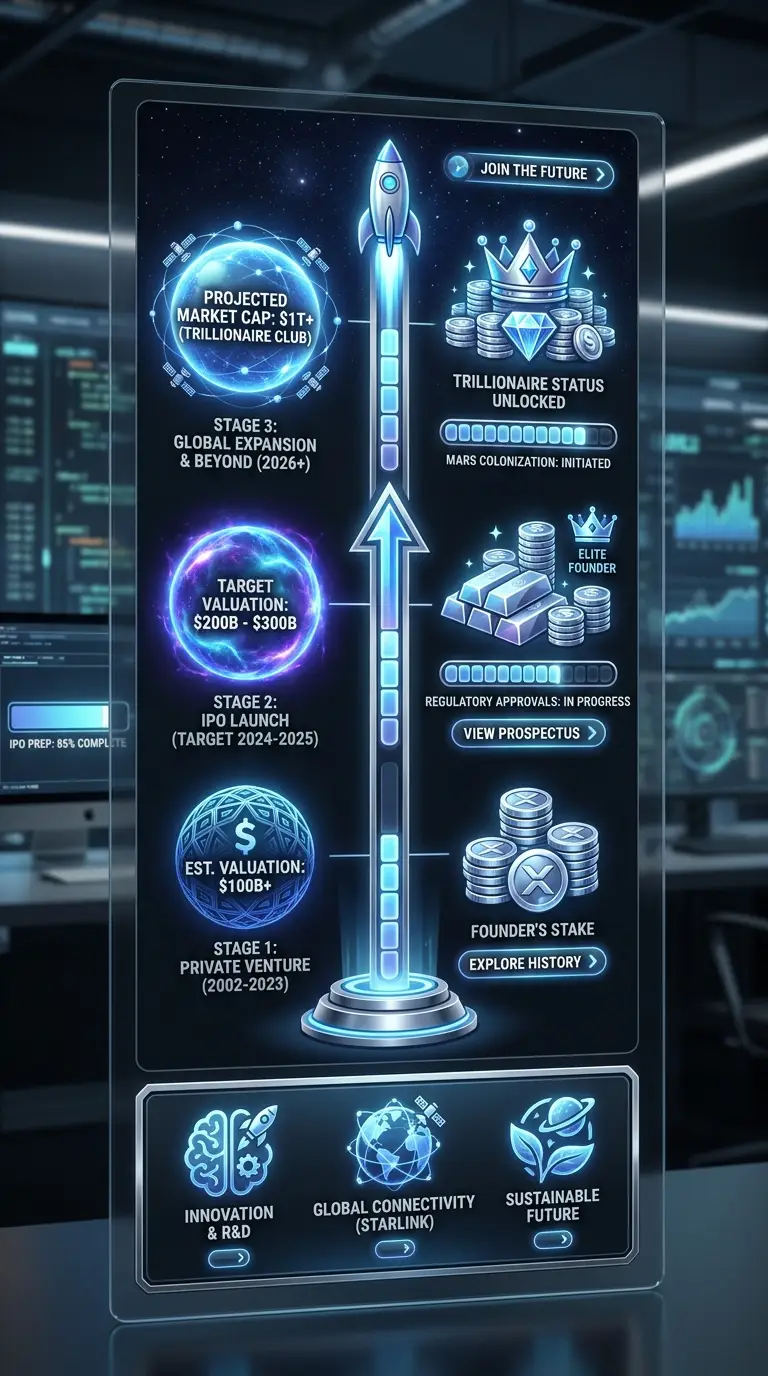
That helps explain why the story drew in so many casual readers. It brought together rockets, satellites, defense, internet service, Elon Musk branding, and one of the biggest wealth jumps ever seen, which obviously grabs attention fast. For people who follow empire building, this looked less like a typical IPO and more like a major change in how the market prices frontier technology. That is probably why interest spread far beyond regular market watchers.
Why Investors Were Willing to Pay So Much for spacex ipo news Stocks
A lot of people hear trillion-dollar valuation and think, “That sounds impossible.” But valuations this high usually come from equally big stories, and SpaceX has several of them, probably more than most companies.
First is launch leadership. SpaceX has become a major player in the global launch market. It flies often, lowers costs, and has built a reputation for actually delivering. For investors, that makes the core business feel exciting, but also based on something real. It is not just an ambitious idea. It is an established business, and that usually matters a lot when serious money is involved.
Starlink may have been an even bigger reason public investors became so interested. It is not some side project off to the side. It is a satellite internet network with global reach, and that changes how people see the company’s future. Launch can be cyclical. A subscription internet business can seem steadier and often easier to scale. So if investors believed Starlink could keep adding users, they were probably valuing SpaceX more like a telecom giant or platform company than a traditional aerospace firm. In many cases, that kind of shift changes the whole valuation story.
There is also the Musk premium. Love him or hate him, Elon Musk affects demand. Some investors buy based on numbers, while others are drawn in by the story around the company. Musk creates that belief on a massive scale. That can push expectations higher for future products, contracts, and market share, sometimes beyond what the current business alone would support.
Then there is scarcity. For years, regular investors had no easy way to buy SpaceX, and that demand kept building. When a private company gets very large, public access can start to feel like a real event. That helps explain why spacex investment opportunities became such a popular search topic. People were not only buying a stock. They were buying access to a company many had wanted for years.
Real SpaceX Investment Opportunities Before and After the IPO and spacex ipo news
Before the IPO, direct access was hard to get. Reuters and other outlets reported possible timing, but many people still ended up looking for indirect ways in, which was honestly frustrating.
That explains a key point here. In practice, when people talk about spacex investment opportunities, they usually mean one of a few different things, and it’s helpful to know which one.
Direct public shares
After an IPO, this is probably the easiest route. You buy the stock through a regular brokerage account, which is nice, and the process is pretty simple. But it can also become the most expensive option if the market jumps in early, and that often happens.
Pre-IPO funds or private market vehicles
These can sometimes hold shares in private companies, which may sound useful. But fees are often high, access may be limited, and pricing is usually not very clear.
Indirect exposure through related companies
As the commercial space sector grows, suppliers, satellite firms, aerospace contractors, and even companies in related markets can often benefit too, not just the obvious players. That broader reach probably matters.
Thematic investing
Some investors choose ETFs built around space, defense, advanced technology, or similar themes. That usually helps spread risk across several companies, which is often the main point. But it can also mean less direct exposure to a single company like SpaceX, if that was really what you wanted.
For more insights on Elon Musk’s broader ventures, see Elon Musk Business Empire and Elon Musk Net Worth June 2026, which give deeper looks at how these valuations connect across companies.
The best choice depends on your goals. If you wanted a pure SpaceX bet, public shares would probably be the more direct option. But if you mainly wanted exposure to the growth of the space economy through a broader mix of companies, a wider approach could make more sense. Maybe less exciting. Still, it’s often the smarter move.
The Risks Hiding Behind the Headlines and spacex ipo news Coverage
Big stories often come with big risks. That is true for any IPO, and maybe even more for one getting Elon Musk-level attention, which, honestly, is a lot.
One clear issue is valuation risk. A company can be world-class and still end up priced too high. If the market expects constant growth every quarter, even solid results can still disappoint investors. That kind of setup usually creates pressure quickly.
There is also execution risk. SpaceX works in tough businesses. Rockets can fail. Regulations can become tighter. Defense and government work can shift with politics, and that often changes fast. Satellite internet brings its own challenges too, including competition, massive infrastructure costs, and ongoing service issues.
Leadership concentration is another risk. Musk is a major draw, but he also runs multiple companies and tends to get strong reactions from public markets. That can add extra volatility, and in most cases, it is hard to ignore.
A more subtle concern is narrative fatigue. Early on, the market may reward every ambitious idea. Later, investors usually start asking the less exciting questions: What are margins? How durable is growth? What is capital spending? When does hype start turning into steady cash flow? That is often the point where sentiment begins to shift.
So while the spacex ipo news cycle can make the stock seem unstoppable for a while, that feeling usually does not last. An exciting business should not be confused with a low-risk investment. Smart investors plan for pullbacks ahead of time, so they do not get caught off guard.
How This Connects to Empire Building and Money Games
For this site’s audience, the SpaceX story is not just a Wall Street story. It is really about scale. It shows what empire building can look like when one company can shift one person’s net worth by hundreds of billions of dollars in just a few days. That is probably the part that grabs people first, and usually the part that is hardest to really picture.
That is also why the topic fits so well with a game mindset. In idle games and business-building games, players usually start small, build systems over time, unlock multipliers, and then reach those sudden huge jumps. Real life is obviously much more complicated, but from a distance Musk’s business world can still feel familiar in that same way. Tesla stock moves, SpaceX valuation rises, and the larger empire grows fast. In many cases, that is a pattern players already recognize, just in a much messier real-world version.
That is part of what makes Spend Elon Musk Money an interesting reference point. It works as a simple example, giving casual readers a playful way to understand the scale of Musk’s fortune. When SpaceX allegedly added $165 billion to his wealth in one day, that number is hard to picture in everyday terms. Interactive money and empire-building experiences can make that kind of scale feel a bit more real.
For readers who enjoy business strategy, there is a useful lesson here too. SpaceX did not build value from one product alone. It built value by combining launch services, satellite internet, government relationships, engineering brand power, and founder visibility. Arguably, that kind of stacked strategy is often how business empires grow.
What Happens Next for SpaceX and the Market
If the reported post-IPO surge holds, the next stage will probably come down to proof. A strong debut can get markets excited early, but that kind of reaction usually does not last unless something real starts backing it up. In cases like this, early excitement tends to stay only when the numbers start to match the story.
A few things will likely draw close attention from investors. One big question is the revenue mix: how much comes from launches, and how much is really tied to Starlink? Profitability will matter too. Fast growth gets noticed, but profits usually do more to calm nerves. Capital intensity is part of the picture as well. Space is expensive, and investors will want clearer signs that SpaceX can turn very large spending into returns that last over time, not just a short burst of momentum.
There is also the broader market angle. If spacex stock launches successfully, other large private companies may feel more confident about going public. It may also lead analysts to rethink how frontier industries are priced, especially space and defense-related businesses. And if investors stay willing to pay premium prices for companies connected to strategic infrastructure, recurring subscriptions, and defense relevance, that could lift other firms too, at least in theory.
Even so, the next chapter may not unfold neatly. Some IPOs jump first, then cool off and reset. Others move around quite a bit while the market works out a fair range. Bigger hype usually makes that process messier, with more volatility before prices settle.
Frequently Asked Questions
In the context used for this article, yes, SpaceX reportedly debuted on Nasdaq on June 12, 2026. Earlier reporting from Reuters and The Wall Street Journal showed that before that point, there was no official filing yet and the company was still viewed as preparing for a possible 2026 listing.
It mattered because the reported debut valued SpaceX at a level usually reserved for the very largest companies in the world. It also pushed Elon Musk’s net worth sharply higher and signaled that public investors were willing to pay a huge premium for space, satellite internet, and Musk-led growth.
Possibly, but they may look different now. Direct stock ownership is easier after a public listing, but valuation risk is also higher after a major rally. Some investors may prefer slower entry, smaller position sizes, or indirect exposure through broader space or defense investments.
No. SpaceX is only one part of Musk’s larger world. Tesla, xAI, X, Neuralink, and other ventures each carry their own risks and value drivers. If you want to better understand the scale of that empire in a more visual way, tools like Spend Elon Musk Money can help put the numbers into perspective.
Most of his wealth is tied to company ownership, not cash. When markets reprice companies like Tesla or SpaceX, his net worth can rise or fall by huge amounts in a very short time. That is why the money-per-second idea has become so popular for explaining his wealth swings.
Start with three basic questions: what is the company worth, what business lines drive that value, and what changed this week? If you want a lighter way to connect Musk’s wealth story with business-building ideas, Spend Elon Musk Money fits well because it turns giant numbers into something easier to understand.
The Bottom Line for Fans, Investors, and Curious Readers
The SpaceX IPO story is about more than a stock ticker. It shows how private-market hype became public-market reality, how one company’s debut may have helped create the world’s first trillionaire, and how investors were pricing in huge future potential in real time, which is pretty wild. It marked a big shift. The main facts behind the spacex ipo news still matter: private valuations reportedly climbed to around $400 billion before the public launch, the debut was said to value the company at about $1.8 trillion, and the follow-up rally reportedly pushed it past $3 trillion within just a few days.
For readers, a few lessons probably stand out:
- A spacex initial public offering can be exciting, but the price still usually matters just as much.
- SpaceX investment opportunities can be real while still carrying risk.
- A spacex stock launch can reshape entire sectors like aerospace and satellite markets, not just one portfolio.
- Elon Musk’s wealth comes from ownership stakes and market swings, not simple cash earnings.
- Empire building often works best when more than one business engine is growing at the same time (I think that’s one of the clearest takeaways).
If someone is watching this story as an investor, patience probably helps. For Musk fans, the headlines tell only part of it, and the business model is worth a closer look. And for anyone simply trying to understand what numbers this huge actually mean, it helps to keep using tools, examples, and interactive experiences that make extreme wealth easier to picture and compare with everyday money. In my view, that makes the scale easier to understand in a more practical way.